Discover
Istanbul
Quick facts
- Country: Turkey
- Currency: Turkish Lira (TRY)
Talk to a travel expert
Why book with Great Times
24/7 Expert Support
Wherever you are, whenever you need us, our travel experts are ready to help.
Exceptional Value
Competitive fares and carefully selected travel experiences help you get more from every journey.
Award-Winning Service
Top Travel Agent, 2016 (Air Arabia Awards) — professional expertise and a commitment to excellence are at the heart of everything we do.
150K+ Travelers
More than 150,000 travelers have trusted us with their journeys.
Accredited & trusted




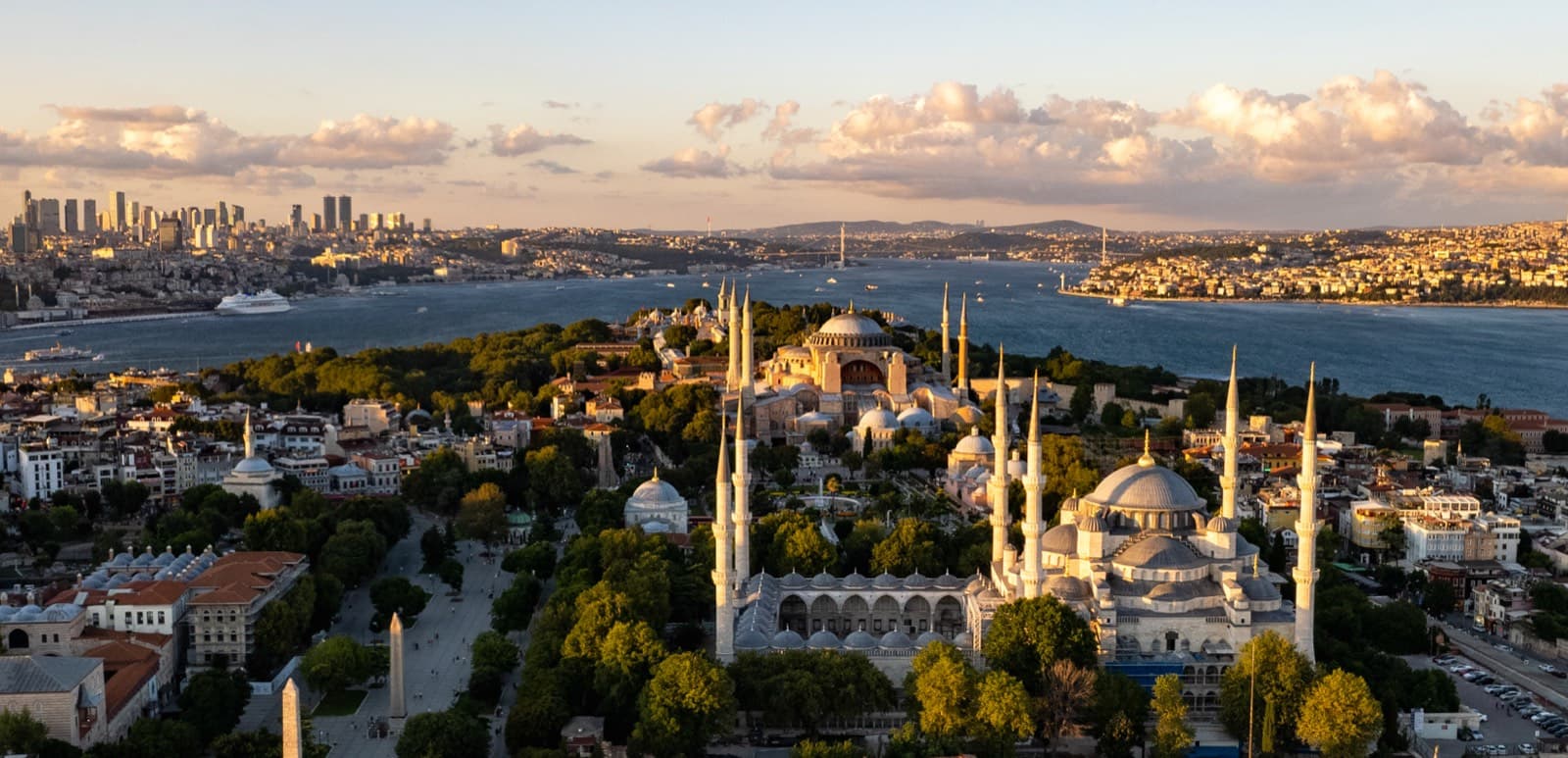
Istanbul, Turkey — one of the real routes we help travelers book flights to.
Country
Turkey
Currency
Turkish Lira (TRY)
History
Istanbul's history begins around 667 BC as Byzantium, a Greek colony on the Bosphorus prized for its command of the sea route between the Black Sea and the Mediterranean. In AD 330, the Roman emperor Constantine the Great refounded the city as Nova Roma, soon known as Constantinople, and it served as capital of the Eastern Roman (Byzantine) Empire for over a thousand years. Constantinople fell to the Ottoman sultan Mehmed II in 1453, after which it became the capital of the Ottoman Empire and grew into one of the largest cities in the world, adding mosques, palaces and covered markets over the following centuries. The city kept the name Constantinople in official use even after the Ottoman Empire's fall until the Turkish postal service formally adopted Istanbul in 1930. It straddles Europe and Asia across the Bosphorus Strait and remains Turkey's largest city and commercial centre, though Ankara has been the political capital since 1923.
Top Sites to Visit
Hagia Sophia
Built 532-537 under Emperor Justinian as a cathedral, converted to a mosque after the 1453 Ottoman conquest, turned into a museum in 1935, and reconverted to a mosque in 2020.
Sultan Ahmed Mosque (Blue Mosque)
Built 1609-1616 under Sultan Ahmed I, notable for being the first mosque built with six minarets and for its interior of more than 20,000 handmade Iznik tiles.
Topkapi Palace
Former residence and administrative seat of the Ottoman sultans, with roughly 300 rooms and a Harem complex, overlooking the Bosphorus.
Grand Bazaar
Covered market whose construction began in the winter of 1455/56 under Mehmed II; today one of the world's largest covered markets, with around 4,000 shops across dozens of streets.
Basilica Cistern
Underground water reservoir built in 532 under Justinian I, supported by 336 columns and once able to store up to 80,000 cubic metres of water for the Great Palace.
Dolmabahce Palace
19th-century Ottoman palace on the Bosphorus, opened in 1856 under Sultan Abdulmecid I, with 285 rooms and one of the world's largest collections of Bohemian and Baccarat chandeliers.
Bosphorus Strait
The waterway separating Istanbul's European and Asian sides; passenger cruises run along it past waterfront palaces, fortresses and the Bosphorus Bridge.
Activities
Visit Hagia Sophia, noting it now operates as an active mosque with visiting hours adjusted around prayer times
Tour the Blue Mosque's tiled interior outside prayer times
Walk through Topkapi Palace's courtyards and Harem complex
Bargain for goods across the Grand Bazaar's roughly 4,000 shops
Descend into the Basilica Cistern to see its 336 columns and reflecting pool
Take a Bosphorus cruise past Dolmabahce Palace and the waterfront neighbourhoods linking Europe and Asia
Load an Istanbulkart at a station machine to ride the metro, tram, bus, Marmaray and ferries
Cross between the European and Asian sides by public ferry across the Bosphorus
Conferences & Sporting Events
Istanbul Biennial — next (19th) edition running 18 September to 14 November 2027
Contemporary art biennial organised by the Istanbul Foundation for Culture and Arts (IKSV), first held in 1987; the 2027 edition is curated by Liu Ding and Carol Yinghua Lu.
Travel Tips
Card payment is widely accepted in hotels, restaurants and malls, but keep Turkish lira cash on hand for the Grand Bazaar, street vendors, small neighbourhood shops and taxis.
When paying by card, choose to be charged in Turkish lira rather than your home currency if the terminal offers a choice — accepting the foreign-currency conversion usually costs more.
Buy an Istanbulkart from a vending machine at any metro, tram or ferry stop to pay for the metro, tram, bus, Marmaray and ferries — it is cheaper per ride than single-use tokens and one card can be shared between several people tapping in turn.
Hagia Sophia and the Blue Mosque are active mosques; visiting hours for tourists are restricted around the five daily prayer times, and modest dress (covered shoulders and knees, headscarf for women) is required.
Keep small-denomination lira notes on hand, since taxi drivers and small vendors often cannot break large notes.
The Bosphorus divides the city into a European and an Asian side; check which side an address is on before booking a hotel or planning a day's sightseeing, since crossing takes a ferry or a long bridge/tunnel route.
How you'll pay
Card via Stripe
Card or mobile money via DPO
Card or mobile money via Pesapal